TCDF LAUNCHES NEW WORKFORCE DEVELOPMENT PROGRAM
June 23, 2022
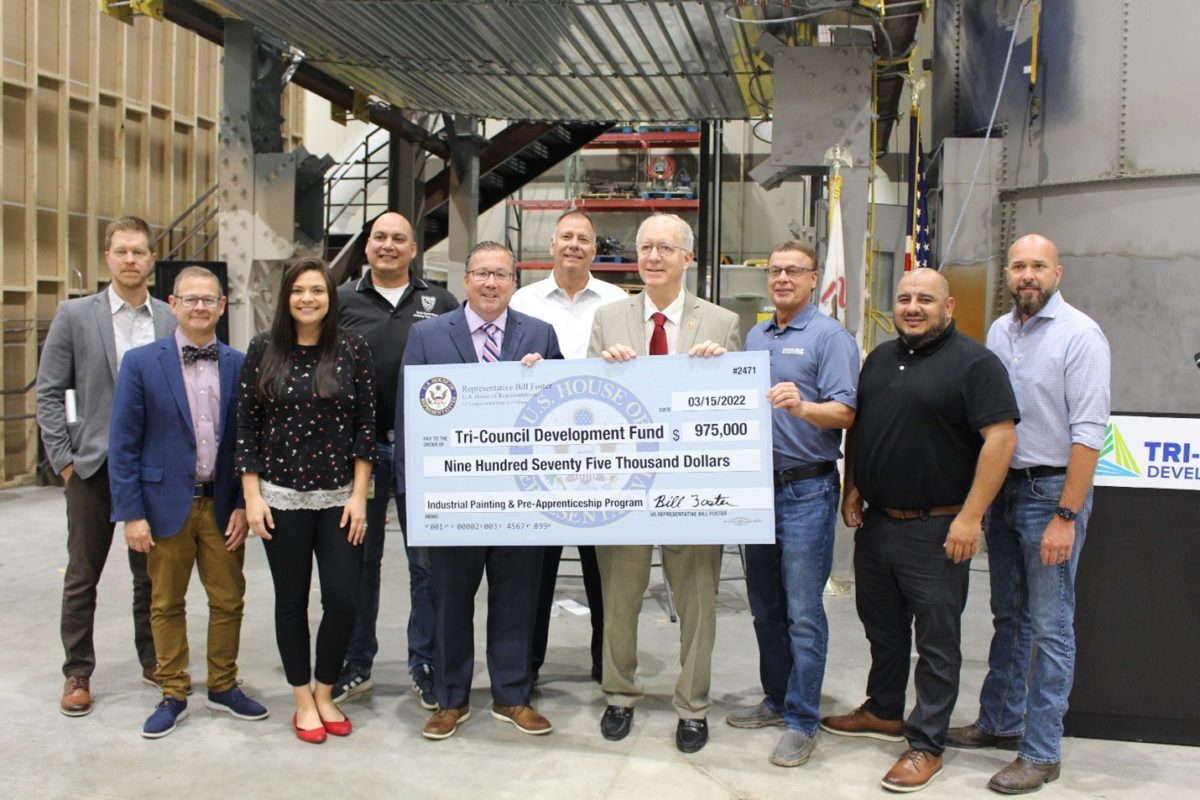
The TCDF has launched a new Industrial Painting Pre-apprenticeship program that will help keep Illinois’ community infrastructure strong while providing valuable training and life skills to apprentice candidates.
Made possible through a federal Community Project Funding award of $975,000 included in the Consolidated Appropriations Act signed into law by President Biden in March, the Industrial Painting Pre-apprenticeship will be a unique workforce development partnership that brings together the three apprenticeship programs in Illinois affiliated with the International Union of Painters and Allied Trades (IUPAT) to prepare the next generation of Illinois’ industrial painters.
Representatives from the TCDF’s partnering IUPAT district councils and their affiliated contractor associations gathered at the Aurora-based North Central Illinois Finishing Trades Institute on June 17 to announce the receipt of the award. U.S. Representative Bill Foster carried the funding proposal in Washington and was on hand to launch the program, which is being sponsored by the TCDF.
“This is a story about training the next generation of painters needed to care for our vital infrastructure,” said TCDF executive director, Todd Dotson, at the launch event. “We wouldn’t be able to tell that story were it not for Representative Foster’s willingness to learn about the training needs in the industrial painting sector and how workforce development in this area is an essential part of maintaining and improving our state’s infrastructure.”
Speakers at the event outlined the need for repair, replacement, and upgrades to public infrastructure systems of all types, and how demand for industrial painting work and workers is expected to grow rapidly. In Illinois alone, Dotson reported in his remarks, the American Society of Civil Engineers recently found that more than $27 billion was needed for maintenance, repair, and upgrades to public drinking water and wastewater systems and that more than 2,400 bridges across the state were structurally deficient.
Representative Foster emphasized the critical role of training to keep up with technological advancements and create career opportunities. “The future of work will look much different from what we remember growing up,” noted Foster. “We need to invest in training and apprenticeship programs that enhance and expand people’s marketable skills, opening doors to the types of jobs that can support families and allow people to build secure lives. The TCDF is a critical component of just that. In partnership with the Illinois union finishing trades industries, they’re helping to strengthen our middle class while expanding opportunities to enter trade careers.”
Stephen Lefaver, Director of the North Central Illinois Finishing Trades Institute, one of three union apprenticeship programs that train industrial painters in Illinois, described industrial painting as “the most challenging painting work performed in the finishing industry,” adding that it is “highly specialized work that should be performed only by trained protective coatings specialists.” This includes, according to Lefaver, training in scaffolding and rigging, the science of corrosion, the use of high-powered blasting equipment, the application of specialized coatings, and health and safety protocols to keep themselves, their coworkers, and the public safe when the work is being performed.
The industrial painting sector is a complex segment of the finishing trades that focuses on applying industrial coatings to steel and concrete surfaces, such as those found in bridges, water towers, treatment plants, and many other types of vital community infrastructure. The funding will enable the TCDF, in partnership with the IUPAT training centers, located in Chicago, Aurora, and Collinsville, Illinois to provide career readiness training free of charge for as many as 100 students.
The program partners are also committed to working with community organizations to identify minority and female job seekers and members of other historically underserved or underrepresented populations who might wish to consider the industrial painting trades as a career.
“In designing the program, we plan to devote a significant amount of the funding to student support, providing the resources to address significant financial barriers that often exist for those seeking to enter into the building trades workforce, helping them thrive during the early days as an apprentice and get on a path to long-term employment,” says Dotson. Support for costs associated with transportation and childcare and stipends for time spent in the program are examples of the type of support Dotson says are needed while participants learn whether industrial painting is a career they can thrive in.
Dotson is excited to launch the program: “The IPP will help build workforce bench strength in the industrial sector to ensure that these critical community projects get done right and on time and budget. This program is a win-win-win for workers, contractors, and communities.”
Market insights you can use, delivered in a single bite.
Retail Sector
Already battered by consumers’ historic pivot to online shopping, few other sectors of the construction economy were pummeled as much by the effects of pandemic lockdown and its aftermath as bricks-and-mortar retail. As shopping districts – particularly those dependent on daytime office traffic – emptied out and consumers withdrew ever farther into their insular online worlds, some wondered if traditional retail was altogether doomed.
Now, however, there are new signs of growth for the sector – even as the national economy struggles to recover. The International Council of Shopping Centers, for example, recently reported that same-store sales – long a bellwether metric for the industry – rose to record levels for most retail categories in the first quarter of 2022, demonstrating a surprising sector resilience.
Rising sales volumes have led to increased leasing activity and, as a result, higher asking rents. And as available space shrinks in premier shopping corridors, we anticipate increased construction activity to follow.
In the Chicago region, according to CoStar, the overall retail vacancy rate now stands at 5.8% – down from 6.5% in late 2020. Absorption levels are also increasing, with CoStar further reporting that Chicago ranked fourth in the nation for retail move-in gain year-over-year.
According to CoStar, at the end of the first quarter there were 1.4 million square feet of retail space under construction across the Chicago Metro – double that of last year. The “glass half empty” view is that construction activity remains low by historic standards. However, the “glass half full” view is that increasing in-store activity and relatively low supply will mean increasing near- and longer-term demand for new retail construction as the economy stabilizes and strengthens.

In late 2021, the TCDF’s Corrosion Illinois Network launched its Asset Protection Program unsure if such an innovative approach to community infrastructure protection would be embraced by communities across Illinois. Now, less than one year later, an increasing number of communities are answering a resounding YES.
Through the program, the Corrosion Illinois Network offers technical assistance and funding to Illinois’ community water systems for the creation of ten-year Asset Protection Plans. These plans include the inspection and evaluation of all water supply and wastewater treatment assets by a licensed, experienced engineering firm and the development of plans for maintenance, repair, or replacement as necessary.
In order to ensure that asset protection planning results in increased system safety and stability – and long term cost savings communities – the program requires that water system owners and operators agree to use Corrosion Illinois Network-certified contractors for all corrosion prevention and mitigation work stipulated in the plan. Contractors achieve CIN certification based on their ability and willingness to adhere to industry standards and best practices. In addition, they are required to follow all applicable state and local laws and regulations and must be affiliated with a federally accredited vocational school that offers the highly specialized training and certifications required to achieve the highest skill level in industrial coatings application.
Twelve communities across the state have already taken advantage of the program, with asset inspections and plan development now in process by engineers from Robinson Engineering. Moreover, many other communities have expressed interest and are taking steps to adopt the program for their water systems.
On the heels of its initial success, the CIN is preparing to expand the program to ensure that any community, regardless of available resources, can take advantage of it and help ensure long-term protection of its vital water system infrastructure.
“We are extremely excited about the future of this program,” said Zach Lowe, TCDF’s Director of Planning and Programming. “The initial feedback has been a strong incentive to move forward as quickly as possible. There is obviously a huge need for the services we are offering as communities become more acutely aware of the importance and challenges of protecting their infrastructure for public health, cost savings, and community growth.”
For more information on the Asset Protection Program, visit https://corrosionillinois.com/corrosion-illinois-network/.
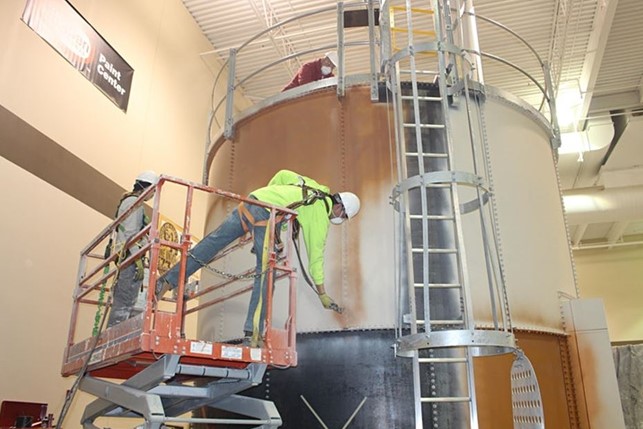
In recent discussions with community water system operators across Illinois, the Corrosion Illinois Network (CIN) – the TCDF’s flagship infrastructure resilience initiative – found that the biggest challenges communities often face in maintaining safe and reliable drinking water and wastewater treatment systems are identifying and planning for maintenance needs and securing project funding.
Both challenges will be addressed in an upcoming “lunch and learn” program to be presented by the CIN on March 9, 2022. The program, entitled “Water Solutions,” will dive deeply into the maintenance and repair challenges familiar to water system operators and the municipal officials charged with overseeing community water systems.
The program, to be held at the Painters District Council No. 30 facility in Aurora, will include informative presentations by corrosion industry leaders on issues that impact all drinking water and wastewater systems, including the high – often hidden – costs of corrosion and what communities can do to maintain their water system assets in good working order. Additionally, the program will provide guidance and insights on how proper maintenance planning can help significantly reduce operating costs – as well as how communities can prepare to successfully apply for water system project funding.
The program is the first in a series that the CIN plans to replicate across the state. According to TCDF executive director, Todd Dotson, “These issues – maintenance and project funding – are faced by all communities, no matter how big or small. The role of the CIN is to help give communities the upper hand on corrosion, with the tools to deal with it and, ultimately, to stop it before it starts.”
Dotson notes that developing resilient water infrastructure is key to helping communities reduce water utility costs and capital expenses, safeguard public health, and position themselves for growth.
Attendees at the Water Solutions event will also enjoy opportunities to network with colleagues over coffee and lunch. Additionally, the nationally accredited North Central Illinois Finishing Trades Institute – housed in the Aurora facility – will offer tours of their state-of-the-art training facility, where teaching staff utilize sophisticated instructional tools to train finishing trades workers in the highly specialized techniques of surface preparation and industrial coatings application on steel and concrete surfaces such as those found in water towers and bridges.
This event is free, but registration is required, and space is limited. For more information and to register, visit the event registration page.
Market insights you can use, delivered in a single bite.

Single Family Rental Market
Since the advent of FHA loans and other financing tools geared toward first-time home buyers, the pattern has been the same: young apartment-dwelling adults preparing for, or just starting, families of their own give up their rented apartments to purchase single-family homes offering less density, more space, and outdoor amenities. But for the millennial generation, this pattern has been disrupted by delays in family formation, high levels of student debt, skyrocketing home prices, and, most recently, pandemic uncertainty.
Increasingly, however, there is a new option for these home seekers. While single family rental (SFR) housing (that is, detached single family homes as well as duplexes, townhomes, and other “single address” attached forms) is hardly new, what is new is the level of organization and formalization that has entered this market segment and begun to attract burgeoning interest from many sides, including tenant prospects, residential developers, and institutional investors. With this has come a new generation of so-called “purpose-built” SFR communities – that is, planned developments offering consistent design and branding, centralized leasing, and high-quality units in neighborhood-style developments complete with sought after community amenities. In short, all the trappings of a high caliber for-sale development, but consisting entirely of single family homes for rent.
Need, suitability, and convenience are primary drivers of this growing market segment. Older millennials who need more space as they start families but who aren’t yet ready or able to purchase a home represent a major target market. As do downsizing baby boomers, who like the flexibility of maintenance-free rental living – especially when single level homeplans are an option – but who do not want to move into a multifamily apartment building.
The pandemic has also had an impact – both directly and indirectly – on the SFR segment, simultaneously spurring a desire for more space (for home officing and schooling, as well as simply to put more space between oneself and one’s neighbors) and depleting stocks of existing homes while driving the costs of new home construction (and new home prices) higher. And now, particularly with mortgage rates on the rise and continued tightness in the for-sale market, the SFR segment is poised to become an increasingly popular housing option.
Nationally, SFR homes represent just five percent of all single-family home starts. However, that percentage has been trending upward since the Great Recession. The segment is also attracting increasing interest from developers and institutional investors such as Toll Brothers, Crescent Communities, Blackstone, and JLL.
The major national homebuilder, D.R. Horton, has also invested heavily in the SFR market and, according to a recent CoStar article, is aggressively ramping up its rental business – both in the multifamily and SFR segments. According to David Auld, the company’s CEO, the ramp-up will continue. “Our goal is to deliver more homes because the demand is there,” he said. “When we look at the rental platform, the ability to scale that up and the segment that’s going to create, it’s going to be a real business all on its own.”
In the Chicago market, purpose-built SFR communities are still a rarity, but developer investment is growing along with consumer interest. Several rental townhome developments have recently been built. And just last month, Wisconsin-based Continental Properties broke ground on the 149-unit Avanterra Wolf’s Crossing detached single family home development in Oswego.

What is the community wealth building approach?
Community wealth building is an approach to economic development that strengthens communities while fostering inclusive growth. This approach leverages assets that already exist within a community to create new forms of shared prosperity. Rather than relying on expensive incentives designed to entice outside corporate entities (which may also send profits back to shareholders and distant corporate offices), community wealth building aims to create a resilient infrastructure of locally controlled businesses, powerful and responsive anchor institutions (such as schools, hospitals, and cultural institutions), and new vehicles for driving local economic opportunity.
How do the organized construction trades help build wealth for Illinois communities? Through their operations, business structures, employment practices, and economic impacts, the organized construction trades help build community wealth in many ways.
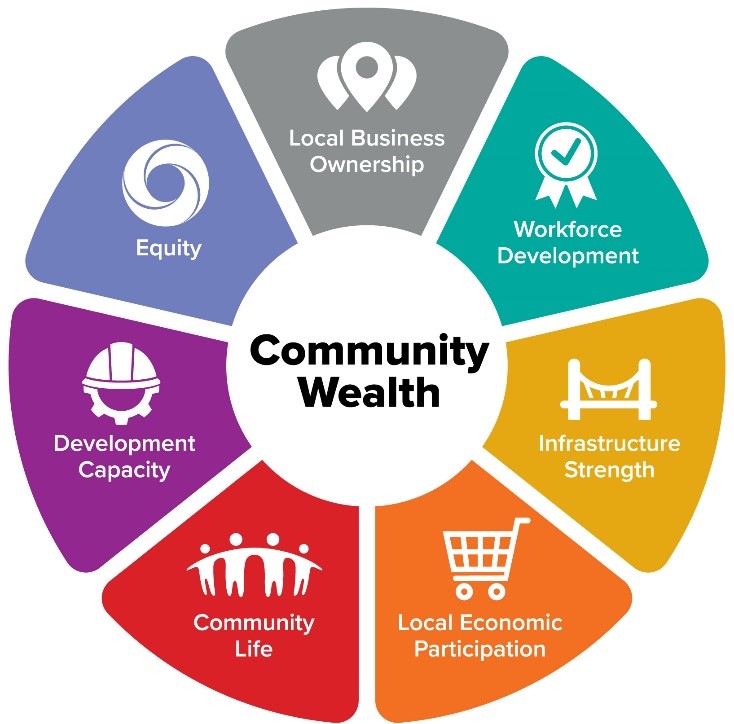
Local Business Ownership
The vast majority of organized construction and contracting firms are place-based small businesses with deep roots in the communities where they were formed. Many are passed down through generations of family ownership. In this way, they provide stable local employment, tax revenues, and other benefits to communities.
Workforce Development
Through apprenticeship and pre-apprenticeship programs, the organized construction trades provide highly valuable training and life skills education that give students -lifelong skills and expertise, leading to career advancement and good, secure employment.
Infrastructure Strength
Strong water, electric, transportation, and other infrastructure systems are vital to community economic growth as well as public health and safety. The organized construction trades deploy the most advanced training, materials, and techniques to keep community infrastructure sound and make it possible for communities to grow.
Local Economic Participation
The family-supporting wages and healthcare, retirement, and other vital benefits that workers earn in the organized construction trades bring economic security to these workers and their families. Union construction workers rely far less on public assistance than their non-union counterparts and have more disposable income to spend in their communities, supporting local businesses and helping to increase the capacity of municipalities to provide needed services to residents and businesses.
Community Life
Workers and employers in the organized construction trades are often actively involved in the life of their communities. Their participation in local government, community organizations, and other civic activities helps to increase community vitality and hometown pride.
Development Capacity
The organized construction trades represent a ready force of highly skilled and experienced crews fully prepared and equipped to handle all types of development projects. These crews make it possible to stand up high-quality buildings and infrastructure that generate revenue and jobs – and do so on time and on budget.
Equity
The organized construction trades are working to help level the playing field for minorities and other traditionally underserved populations. All workers within the organized construction trades are paid a fair and family-supporting wage and have access to vital benefits. Training and employment opportunities offered by the organized construction trades help low-income communities close opportunity gaps and break the cycle of poverty by providing career ladders, entrepreneurial opportunities, and other means of advancement.
Learn More
To learn more about community wealth building, watch Community Wealth Building in the Age of Recovery, our 2020 virtual forum featuring an all-star lineup of community wealth building experts.
Download an enhanced PDF of this article with tips on how communities can harness the power of the organized construction trades to help build community wealth here.
THE HIGH COST OF CORROSION
November 11, 2021

Research from the Association for Materials Protection and Performance (AMPP – formerly NACE International and SSPC) shows that the cost of corrosion can reach $2.5 trillion or higher globally every year – equivalent to 3.4% of global GDP. In the United States alone, the annual cost of corrosion is estimated at more than $450 billion. A large portion of this cost is borne both directly and indirectly by communities.
In communities across Illinois, corrosion has weakened municipal infrastructure systems, impeding community growth and economic development and reducing municipal capacity and prosperity. Crumbling roadways, bridges, and water systems drain resources, increase operational costs, and rob opportunity by discouraging business growth.
Sadly, the economic cost of corrosion is only part of the story. The cost of corrosion in terms of public safety and ecological health is even higher. When corroded structures fail – when bridges collapse, barriers give way, pipes burst, or storage tanks rupture – the results can be both deadly and disastrous for the environment.
But the staggering costs of corrosion need not be an inescapable fact. By using available and effective corrosion control practices, AMPP estimates that savings of between 15% and 35% of the cost of corrosion could be realized – equivalent to between $375 and $875 billion annually on a global scale. More importantly, lives could be saved, and the environment protected.
Proper and effective corrosion prevention and mitigation is highly specialized work that should be performed by trained and certified industrial coatings contractors. Equipment and facilities can last 5-10 times longer when industrial coatings are applied properly by a trained, skilled workforce.
By demanding that industry-leading corrosion control systems and practices be a part of every maintenance and new build infrastructure project, communities, facilities operators, and other stakeholders can reduce long-term costs, increase climate resilience, drive economic development, and protect public safety and the environment.
To learn more about how to stop corrosion before it starts and why protective coatings fail, visit the Corrosion Illinois Network at www.corrosionillinois.com.
Market insights you can use, delivered in a single bite.
Industrial Market
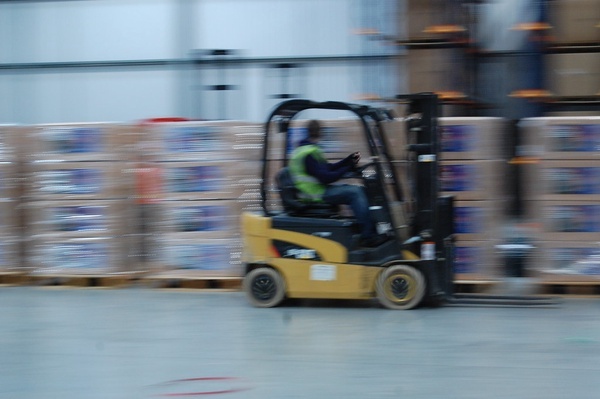
Driven by the logistics sector (comprised of both warehousing and distribution) – and the nation’s seemingly insatiable hunger for consumer goods – the industrial market is on a roll. And it looks like the high times for the industry are here to stay for a while.
Records continue to fall, with the market posting historic or near-historic highs in construction, occupancy, absorption, and asset sales. In the Chicago region, market data firm CoStar reports that 24.6 million square feet of industrial space is currently under construction, much of it destined for logistics uses. Twenty-two million square feet have been delivered over the last 12 months. Yet demand is still outstripping supply, with 28.4 million square feet absorbed during that time, driving the regional vacancy rate down to just 5.6 percent.
Not surprisingly, rents have responded to the intense demand, growing 6.3 percent over the last year, compared to a historic average of just 2.3 percent.
CoStar’s list of top leases signed over the last 12 months tells us something about who we became in the pandemic: Harbor Freight Tools, Clorox Company, Scotts Miracle-Gro, Wayfair, and Walmart all signed deals for million-plus square foot spaces.
Most analysts agree that the heightened market conditions will persist at least through 2022, particularly as the pandemic continues to abate and consumers gain confidence in spending down a portion of their savings – which for many fattened during lockdown conditions.
For Chicago – and Illinois more broadly – the future of the industrial market looks particularly bright as the region will continue to benefit from unmatched transportation connections (particularly rail), a large and ready workforce, and – something that many companies (particularly manufacturers) are increasingly concerned about – an unequaled supply of fresh water.

In December of 2019, the three International Union of Painters and Allied Trades (IUPAT)-affiliated District Councils with primary jurisdiction in Illinois and their allied Contractors Associations agreed to form a new labor-management alliance to help communities across the state achieve their community and economic development goals. That alliance, which became the TCDF, will celebrate a milestone next month as it reaches two years of operations.
From the start, the TCDF’s work embodied the belief that everyone has a right to economic opportunity and that communities benefit when more individuals have the means to fully participate in their local economies.
During the historic period of turmoil and uncertainty brought by the COVID-19 pandemic, the TCDF has stayed true to its vision of helping to foster inclusive growth. Through this vision, the organization focused its work on community empowerment through four critical areas of community and economic development: infrastructure resilience, workforce development, economic opportunity, and housing balance. According to TCDF Executive Director Todd Dotson, “TCDF partners recognized from the beginning that we all wanted strong communities for our members and employers to live and work in, and as a construction trade we were uniquely suited to work in these focus areas.”
One of the primary activities of the TCDF over the last two years has been to produce original programming that provides new insights into community and economic development issues. To that end, its inaugural program featured a panel of all-star experts in the innovative branch of economic development known as community wealth building. Other programs have included an outlook on the future of infrastructure investment and spending in Illinois and nationwide, as well as an informational program on the ins and outs of new rules adopted by the Illinois Environmental Protection Agency at the end of 2020 to protect critical water supply infrastructure.
The TCDF’s work in community infrastructure resilience quickly grew into a new initiative, called the Corrosion Illinois Network. Developed to be a “concierge service” for infrastructure stakeholders across the state, the Network provides educational programs, technical assistance, and training opportunities in corrosion prevention and mitigation. Through the Network, the TCDF has begun partnering with community water system owners and operators by funding and facilitating the development of plans for maintaining critical system assets such as water tanks, pumping stations, and treatment plants. In doing so, the TCDF helps communities reduce long-term operational costs, protect public health and safety, and maintain robust water systems that are critical for growth.
The TCDF sees a bright future ahead. Moving forward, the alliance plans to add a workforce development initiative to its project list when it partners with the training facilities at each District Council to create a pre-apprenticeship program in industrial coatings application. Work in this field, which is essential to corrosion prevention and mitigation, is both demanding and highly technical. It is also an area that provides significant opportunities for career advancement and household-sustaining employment. “This is a natural space for us to be in,” said Dotson. “While helping communities keep their infrastructure assets healthy, we want to make sure we are training the next generation of industrial coatings specialists, so the bench strength is there to support the industry.”
The TCDF specifically hopes to use its new program to increase the number of women and minorities entering careers in the finishing trades and will be partnering with workforce development organizations across the state to do so.
TCDF HELPS COMMUNITIES PLUG THE HOLE IN WATER RESOURCE PLANNING
August 24, 2021

Each year, the State of Illinois makes hundreds of millions of dollars available in the form of low-interest loans to public water system operators across the state to fund system improvement projects. In fiscal year 2021, for instance, $350 million was made available through the state’s Public Water Supply Loan Program.
This funding is available for community water suppliers who have the capacity to develop a “Project Plan” within Illinois’ Administrative Loan Rules. However, many small or under-resourced community water systems lack the necessary resources to develop these plans, which can be both time-consuming and expensive to produce.
As a result, these systems’ assets often suffer from severely deferred maintenance and repairs, which can lead to system failures that cause service interruptions and pose risks to public health and safety. Moreover, such failures result in increased costs to communities and may curtail healthy community growth.
Now, a new program created by the TCDF as part of its Corrosion Illinois Network seeks to “plug the hole” in water resource planning. The Community Water Supply Asset Protection Program (CWSAPP) will address the initial resources gap that constitutes a barrier for many water systems seeking to put into place sound asset protection plans and seek funding for maintenance, repair, or replacement of individual assets and/or systems.
To do this, the program will provide technical assistance and funds to the water system owner for the creation of a ten-year Asset Protection Plan. This plan will include the inspection of all water supply and wastewater treatment assets by a licensed engineering firm and the development of plans for maintenance, repair, or replacement as necessary. In addition to prioritizing maintenance and repair projects by fiscal year, plans will include project cost projections and a preventive maintenance inspection schedule for each asset. This schedule will provide for regular asset inspection and maintenance to prolong the asset coating system life, thereby controlling corrosion and extending the life of the asset.
With this planning in place, a community is positioned to seek funding for individual projects from state and federal sources. Further assistance will help system operators identify and engage with potential sources of funding for projects defined within the Asset Protection Plan.
All CWSAPP services will be provided at no cost to client water systems. However, to take advantage of the services, the system owner must agree to use only Corrosion Illinois Network Certified Contractors for all protective coating work covered within the plan.
Contractors will be certified based on their ability and willingness to adhere to industry standards and best practices. In addition, they will be required to follow all applicable state and local laws and regulations, including new rules recently adopted by the Illinois Environmental Protection Agency regarding corrosion work on community water supplies. Finally, to be certified contractors must be affiliated with a federally licensed apprenticeship school that offers industrial coatings training and certification. In this way, the TCDF aims to extend the value of the program by creating workforce development opportunities across the state.
“Clean water is no accident,” says TCDF Director of Planning & Programming, Zach Lowe. “It is something that requires careful planning and regular maintenance by qualified industrial coatings contractors. We are excited that this new program will help secure a clean water future for communities across Illinois.”
Communities, contractors, and other clean water stakeholders can learn more by joining the Corrosion Illinois Network for free here.